
Socially Aware Robot Navigation

The service robots deployed in the NAVER ‘1784‘ building in Korea represent a large-scale, real-world testbed for autonomous robots operating in everyday indoor spaces. Moving beyond a robot-friendly dedicated infrastructure, such as the robots’ current “Roboport” elevators, requires navigation policies that allow robots to operate seamlessly alongside people in shared environments. This involves not only reaching a destination, but doing so while accounting for human presence, social context and dynamic conditions.
We investigate this challenge through the scenario of robots entering elevators shared with humans. While seemingly simple, it involves constrained spaces, precise timing and subtle social negotiation over access and priority. Enabling robots to handle such interactions is a key step toward developing navigation behaviours that generalize across environments and social contexts, particularly in high-rise buildings where vertical mobility is essential.
Exploring different approaches to robot behaviour design
Designing robot behaviour for shared spaces raises a fundamental question: to what extent should robots follow human social norms versus adopting distinct, machine-like strategies? While much prior work focuses on human-like behaviour[1], research in human–robot interaction shows that people do not respond to robots in the same way they do to other humans [2]. This suggests that expectations toward robots may differ, and that deliberately machine-like behaviours i.e. leveraging clarity, predictability and efficiency, can sometimes be more appropriate. Such behaviours can also reduce the amount of social understanding required and avoid creating an illusion of human-like social competence [3,4]. Our work explores how to balance these approaches to achieve socially acceptable and effective navigation.
To ground this question in real-world practice, we conducted ethnographic observations of how people use elevators and an online survey to probe expectations toward robot behavior. Results indicate that while human-like behaviors are often perceived as intuitive, participants may prefer certain machine-like behaviors and do not always expect robots to follow human conventions, particularly when prioritizing access or positioning.
Building on these findings, we conducted an in-person Wizard-of-Oz study in which participants interacted with a robot in elevator waiting scenarios. The results highlight a preference for hybrid strategies: fixed, machine-like waiting positions were valued for their visibility and predictability, while flexibility remained necessary to adapt to dynamic situations. Participants also emphasized the importance of clear and timely communication of the robot’s intent, especially when it sought to take priority. These findings point to both the benefits and limitations of predefined behaviours, motivating approaches that can adapt to context while remaining legible to humans.
Beyond proxemics towards embedding context specific social norms in robot navigation
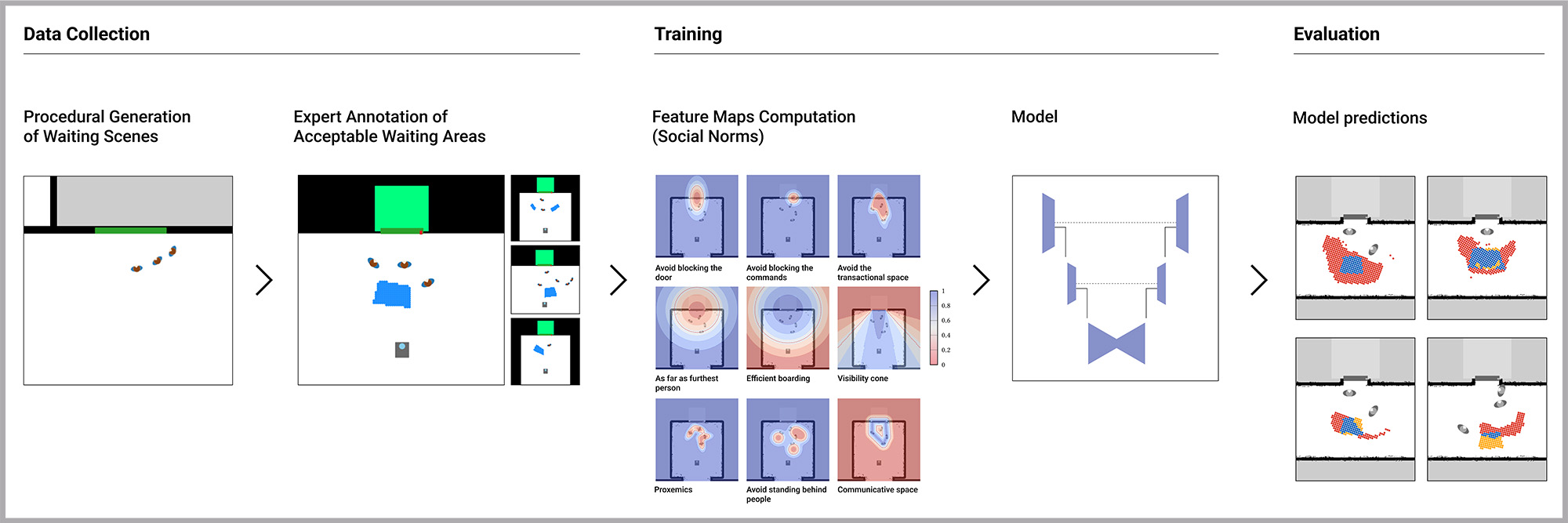
We move beyond fixed positioning strategies by enabling robots to autonomously infer socially acceptable waiting regions in shared spaces and train a model that segments the environment into acceptable waiting areas based on sensory inputs, supported by a set of feature maps encoding prior knowledge about context-specific social norms.
Deployment on a real robot shows that people can often infer the robot’s intent – such as whether it plans to yield or take priority -based on its positioning and motion. However, when the robot asserts priority, positioning alone is not always sufficient: people expect clearer communicative cues to justify this behaviour. In addition, even subtle motion adjustments (e.g. re-orientation or safety-induced pauses) are often interpreted as intentional, sometimes leading people to reassess and reclaim priority. These findings highlight the importance of combining socially aware navigation with explicit communication.
Communicating robot intent
To minimize disruption in contexts where people are likely to encounter a robot on several occasions throughout the day, and to avoid using speech-based communication to limit people’s expectations of what the robot can understand, we’ve also worked on designing non-verbal behaviours for the robot so that it can effectively communicate it’s intent when navigating. The focus of our research is on two modalities: motion and prosody-based sounds. In motion-based communication we’re been inspired by human non-verbal cues and previous research and have designed two different gestures to communicate the robot’s intent when boarding an elevator: a slow backward motion [6] with blue pulsing lights to yield priority/give way [7]), and a slow forward motion (also referred to as anticipatory motion) with an alert sound and directional blue light to claim priority. Both gestures were understood by most of the participants in our user experiment. They perceived the yielding motion as polite behaviour, similar to what people do in this situation, and the step forward as making the interaction faster, but also more aggressive, which is only justified in urgent cases. In sound, we conducted experiments with prosody-based sounds [8] and with the integration of the different communication modalities for evaluation in user experiments.
Video depicting the ‘Yielding’ and ‘Stepping Forward’ communication behaviors of a test robot in NAVER LABS Europe.
Resolving Navigation Blocks
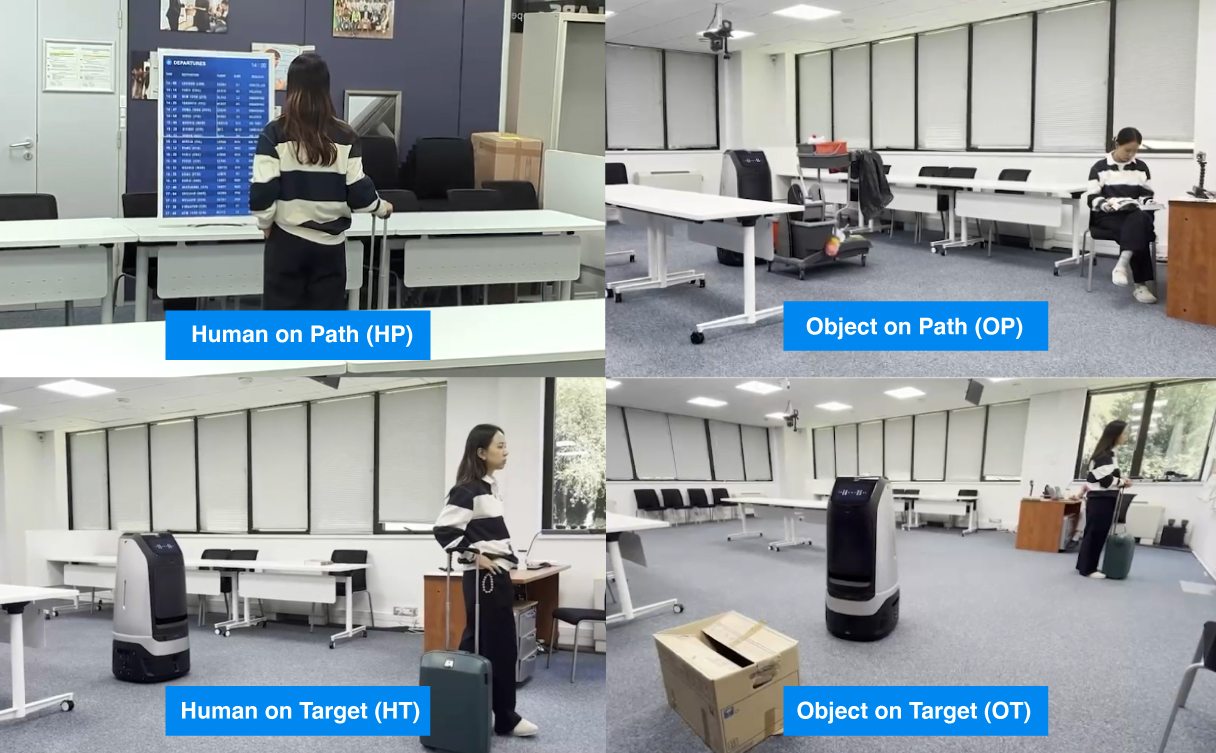
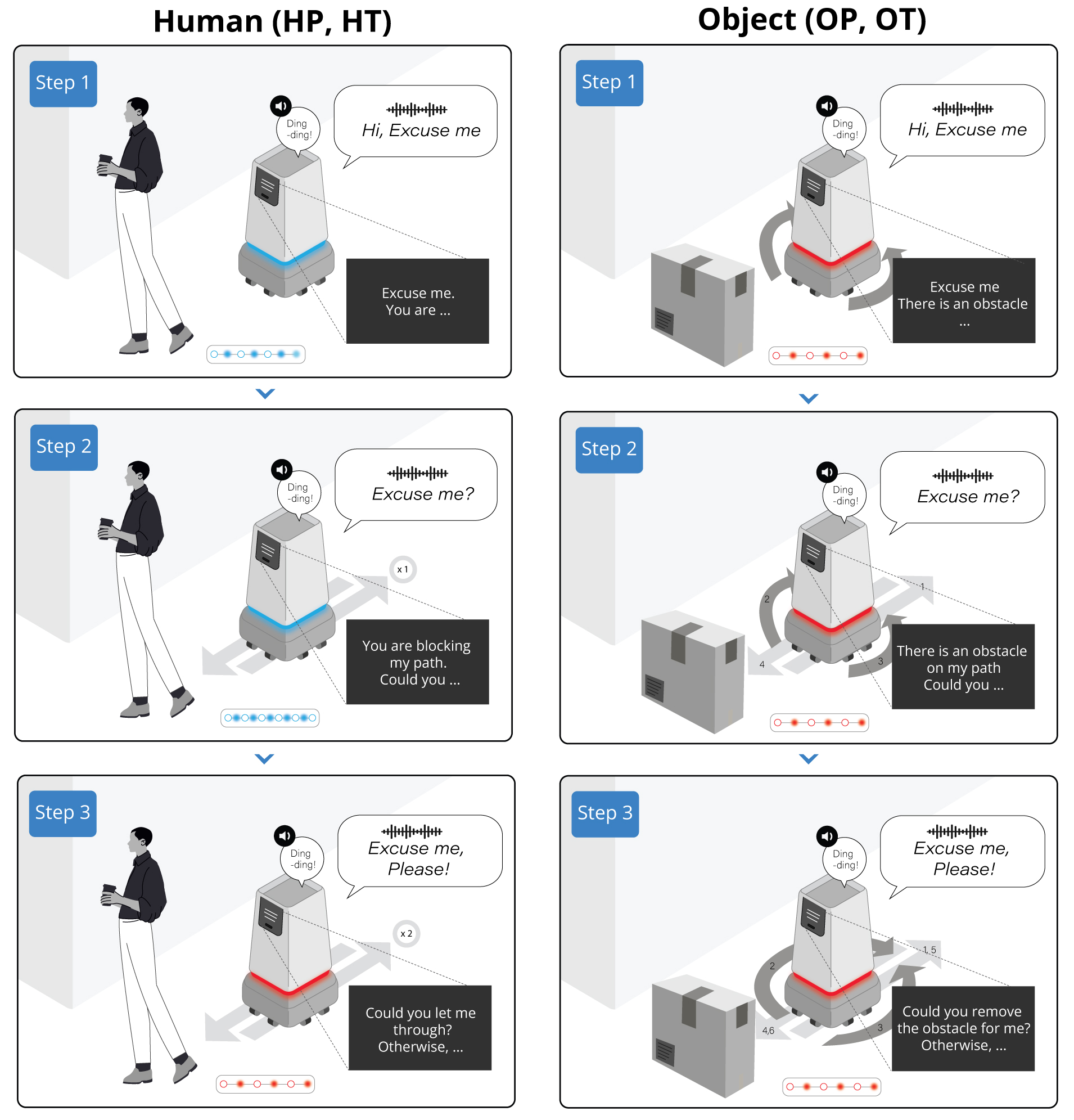
To complement our work on elevators and other shared-space scenarios, and building on our learnings on communication of intent, we investigated how a service robot can resolve navigation blocks when its path or goal is suddenly obstructed. We devised a three-step, multimodal policy that escalates urgency from soft beeps and subtle lights to clarifying motions and concise on-screen messages, politely asking bystanders either to step aside or to move an object, depending on the scenario. Tests with a delivery robot in an airport-like setting showed that people are more willing to help when they are the obstacle themselves, while prompting them to remove third-party items proved more challenging. Sound combined with text was the most effective way to capture attention and convey intent, while additional motion cues had limited impact. Interestingly, people assigned meaning to every robot action within the context of the interaction—even unintended ones, such as those during re-localisation. The sequential structure of human–robot interactions leads people to expect a clear behaviour and timing, which can be easily disrupted by inaccuracies. These insights strengthen our understanding of socially aware navigation, the remaining challenges, and show how even robots with limited sensing can negotiate short, sequential interactions to keep moving smoothly.
Deploying navigation behaviours on real robots in real-world environments is essential for their successful integration and adoption. It requires moving beyond controlled settings and addressing the complexity and variability of human-shared spaces. Our work contributes to this goal by combining empirical insights from human behaviour studies with models that embed context-specific social norms into navigation.
We’re currently extending this work through simulation-driven training of socially aware navigation, with a focus on modelling higher-level human behaviours such as grouping or idling. These richer crowd dynamics allow us to expose robots to more complex scenarios and to train end-to-end reinforcement learning models that can better react in dense, dynamic, human-shared environments. We’re exploring how explicit communication behaviours—such as waiting, signalling or stepping back—can be incorporated into the robot’s action space, enabling it to actively participate in interactions rather than only react to them. Together, these efforts aim to bridge the gap between simulation and real-world deployment, enabling more robust, adaptive and socially aware robot navigation.
Related publications
- Investigating Robot Behaviors to Resolve Navigation Blocks, Jisun Park, Jutta Willamowski, Tommaso Colombino, Danilo Gallo. IEEE RO-MAN 2025.
- Robots Waiting for the Elevator: Integrating Social Norms in a Low-Data Regime Goal Selection Problem, Mattia RACCA, Jutta Willamowski, Tommaso Colombino, Gianluca Monaci, Danilo Gallo. IEEE RO-MAN 2025.
- Prosody only utterance for robot navigation. Inyoung Kim. ACM/IEEE International Conference on Human-Robot Interaction (HRI) 2025.
- Exploring machine-like behaviors for socially acceptable robot navigation in elevators. Danilo Gallo, Shreepriya Gonzalez-Jimenez, Maria Antonietta Grasso, Cecile Boulard, Tommaso Colombino. ACM/IEEE International Conference on Human-Robot Interaction (HRI), 2022. Best paper award.
- Investigating the Integration of Human-Like and Machine-Like Robot Behaviors in a Shared Elevator Scenario. Danilo Gallo, Prescillia Bioche, Jutta Willamowski, Tommaso Colombino, Shreepriya Gonzalez-Jimenez, Herve Poirier, Cecile Boulard. ACM/IEEE International Conference on Human-Robot Interaction (HRI), 2023. Finalist for Best Paper Award.